
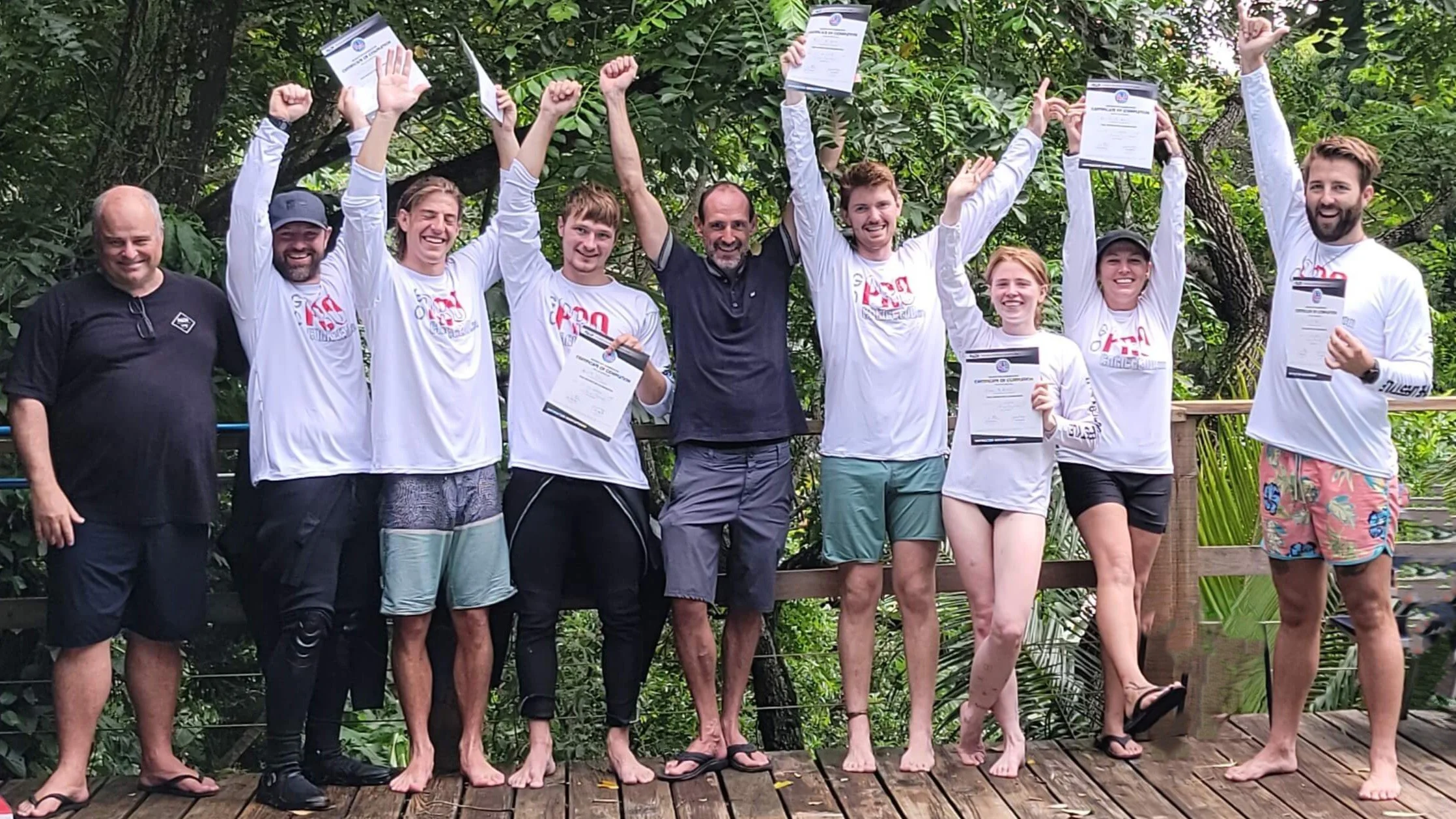
What to expect at the PADI instructor exam (IE)
The PADI Instructor Examination — the IE — is the two-day independent assessment that comes immediately after the IDC on Roatan. It's conducted there by a PADI Examiner who is not part of the training centre, and it's the moment your IDC preparation gets tested under exam conditions. Four segments: Written Exams, Classroom Presentation, Confined Water Teaching, and Open Water Teaching. Two days. One PADI Instructor card on the other side.
Many people say that IE stands for "It's easy" — which in all truth, it should be, if you picked the right IDC centre and Course Director. The four segments below explain exactly what's tested. The section after that explains why the choice of IDC centre and Course Director is the single biggest variable in whether the IE actually does feel easy.
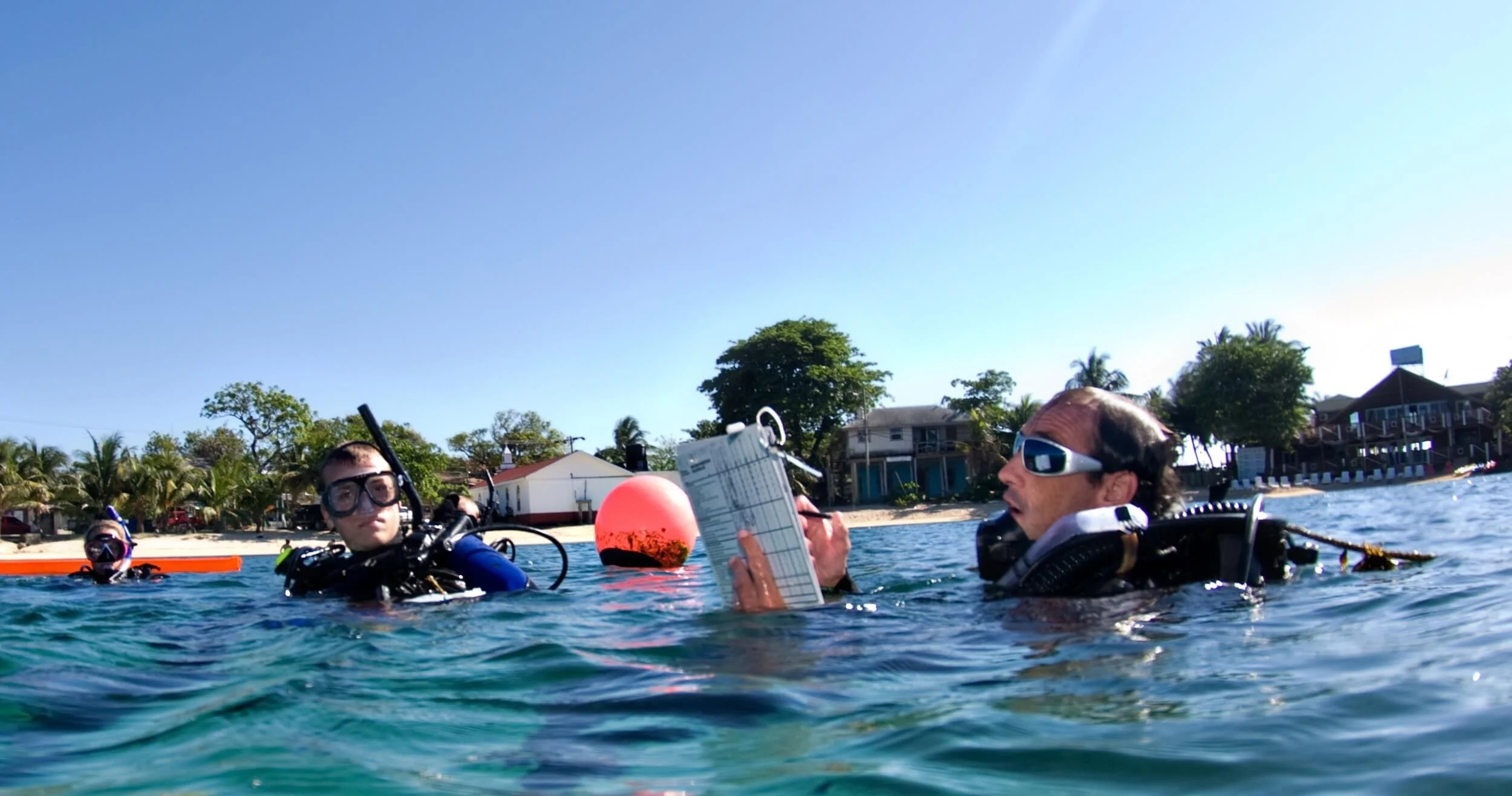
Four segments. Two days. One PADI Instructor card.
Written Exams
The IE includes two sets of written multiple-choice exams: Standards & Procedures, and Dive Theory. You sit each set in a 90-minute window. You need 75% on Standards & Procedures, and 75% on each of the five Dive Theory sections (Physics, Physiology, Equipment, RDP, and Skills & Environment) — twelve questions per section.
Makeups: if you get less than 75% in just one of the five theory exams, you will be allowed to retake that one section the following day. If you fail two or more, or fail the Standards & Procedures exam at your first attempt, you have been unsuccessful in the written exams portion, and would have to attend another IE — at least three days, but no more than 12 months, later. You would have to redo and pass all the exams again to be successful at that attempt.
By the time you sit these at the IE you've already cleared the IDC's own written exams (and the extra practice exams that any good Course Director authors for their candidates), built around the same content. The theory exams are one of the two things that independent pre-IDC preparation makes a huge difference in — and Will runs theory sessions early enough that any gaps in your pre-IDC prep surface in time to fix them — yet the written exams are the most commonly failed segment of the IE. Given that they are the easiest thing to prepare for independently before the IDC, that should not be the case.
PADI’s Pros Blog, in Eight Tips for Rocking Your IDC, quotes Will Welbourn, PADI Course Director with Coconut Tree Divers in Roatan, on preparing for dive theory: “Find practice questions and sample exams online and have a go at them”.
Classroom Presentation
A topic is randomly assigned in the IE orientation. You prepare a 4–8 minute classroom lesson — the length depends on the topic's natural complexity — and deliver it to the Examiner and your fellow IE candidates acting as students. You will be given plenty of time to prepare. You need a 70% score (3.5 on PADI's 5-point scale) to pass. This segment also has a makeup opportunity: if you get below that mark, you will be given time to prepare a second presentation and have another go. Below 3.5 again, and you will have to attend another IE at a later date to retake the Classroom Presentation segment.
What separates a 3.5 score here from a 5.0 isn't depth of topic knowledge. By the IE, every candidate knows the content. What separates them is how you interact with and engage your students, and lesson structure — how the introduction sets up the learning objective, how the explanation builds in the right order, and how the lesson’s value is reinforced at the end. The IDC is the place to learn that structure cold. By the IE day, you should be able to walk into any topic, build a clean lesson plan in twenty minutes, and deliver it without surprising yourself.
Confined Water Teaching
You will teach one skill from the PADI system of education: you give a briefing and a demonstration, your students (the other IE candidates) perform the skill for you, you correct the errors the examiner has asked them to make, and then you debrief. The skill is assigned to you in the orientation session at the start of the IE, and every candidate is given a different skill from the others in their group. You need a score of 3.4.
This segment has a makeup. In the orientation, you will be assigned a makeup skill. If you get below 3.4 on your initial skill, you will be allowed to teach your makeup skill at the end of the confined water session. Get below 3.4 again, and you have been unsuccessful in the Confined Water segment and would have to return to another IE to do this whole segment again (including the five skill demonstrations).
In addition, all candidates will be assigned the same five demonstration-quality skills, randomly selected from the twenty-four skill circuit skills (listed in the Divemaster Course Instructor Guide). You need an average score of 17 out of 25, with no skill less than 3. Makeups: for any skill scored less than 3 you can have another attempt, and if you score less than 17 points you have another go at all five, to secure the 17 points with no skill less than 3. This is the second part of the IE that is easy to prepare for: getting out there and practising the skills over and over again until they are effortless. You do not need an instructor or Course Director watching over you — you can just be your own hardest critic!
CESA — the Controlled Emergency Swimming Ascent — is guaranteed to be one of the five. The other four are drawn at random from the remaining twenty-three, although typically they are drawn from: Remove and Replace Mask, Regulator Recovery, Neutral Buoyancy, Alternate-air Source Use, and Remove and Replace Scuba Unit. However, there is no skill you can leave unrehearsed. Demonstration-quality skills aren't simply "do the skill"; they're slow, exaggerated, students-can-see-every-step versions designed for a learner who has never seen the skill before. We rehearse all of them to demonstration standard, every IDC, in pool or confined open water sessions. This part will be a slam dunk. By IE day, the five randomly drawn skills should feel like the five you most expected.
Will has YouTube demonstrations of the rescue exercises and other key skills available on the Go Pro Caribbean YouTube channel — useful pre-IDC if you want to see what demonstration-quality looks like before you arrive.
Open Water Teaching
One PADI Examiner per eight IE candidates in open water (more often than not, one per four in Roatan’s generally small IE groups, another advantage of choosing Roatan over locations with far larger IE groups). You teach two skills to fellow candidates (usually two or three) playing the role of students. The skills are assigned to you in the orientation session at the start of the IE, and every candidate is given a different pairing of skills from the others in their group. You need an average score of 3.4 across the two. There is no makeup opportunity here. In addition to the teaching presentation of two skills, you will demonstrate Rescue Exercise 7, the unresponsive diver at the surface. This is simply pass or fail. You do get a second chance if the first is not acceptable.
The boat is the boat. The reef is the reef. The Examiner watches you brief the skill, observe the students perform it, correct their deliberate, assigned errors (or unintentional, unassigned ones!), give feedback, and debrief — the same teaching cycle you'll use for the rest of your career. Hours of open water teaching practice during the IDC make this segment feel routine. The candidates who struggle in open water on IE day are usually the ones whose IDCs didn't push enough water time on the actual teaching cycle.
If you fail one or more of the four segments, you will have to attend another IE (at least three days, but no more than 12 months, later) to retake them. The segments you pass you do not have to retake — just any segments you fail. The cost for a retake is $345 per segment.
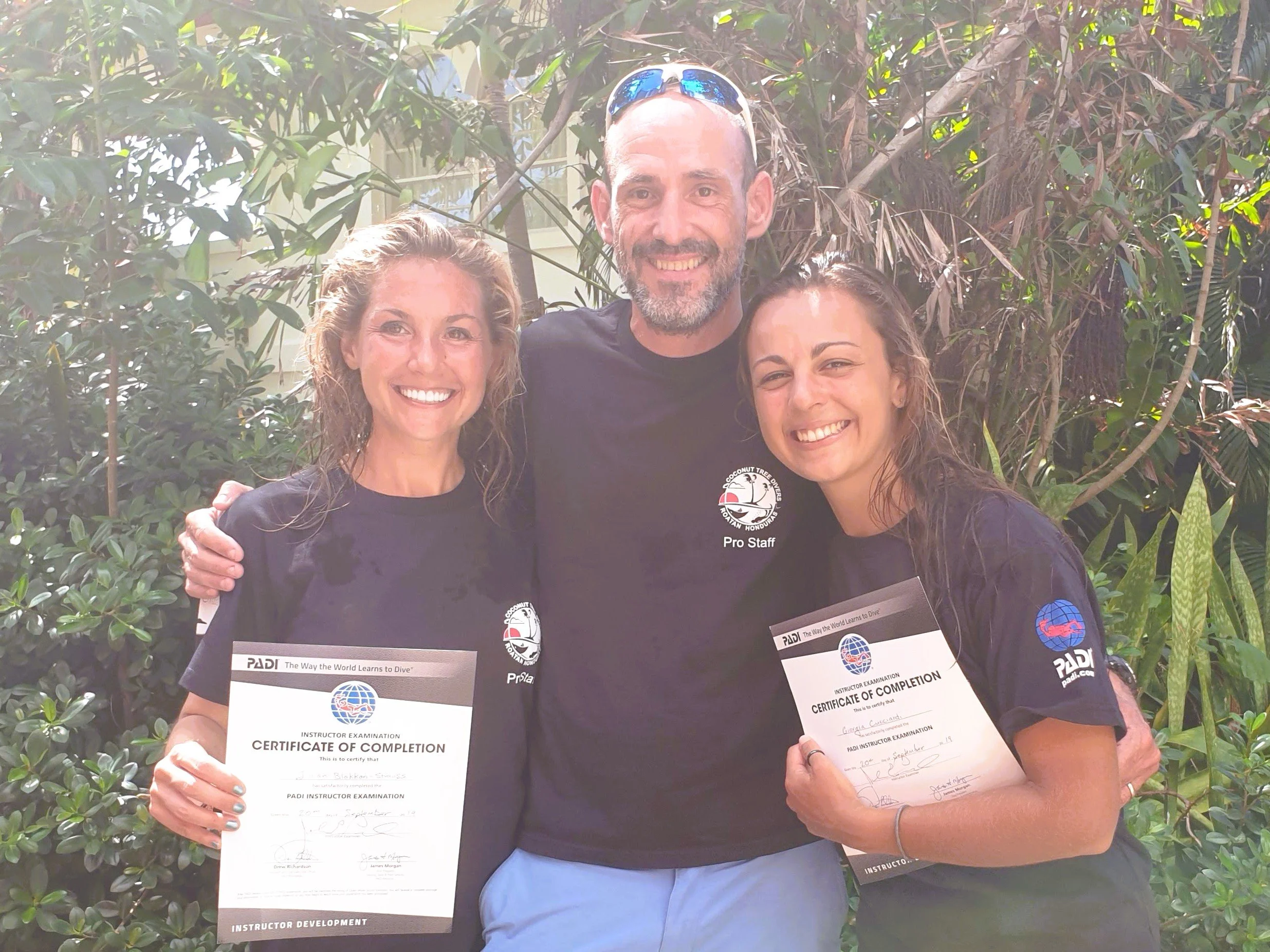
Prepare to succeed, not just to pass.
Why Go Pro Caribbean's IE pass rate matters
Now you know what the IE asks for. The next question is who's preparing you for it.
In the last ten years, every candidate who has completed the IDC with Will Welbourn has passed the PADI Instructor Examination first time. Since Will became a Course Director in 2008, more pros have been certified at Coconut Tree Divers and Go Pro Caribbean than at any other operation on the island, by a wide margin — over 500 PADI instructors.
A 100% IE pass rate over a decade isn't a marketing claim. It's the result of experience — Will has personally taught over 200 IDCs — and of a course built around the actual demands of teaching real courses to real students, which is far more demanding than the IE: demonstration-quality skills rehearsed to standard before they are ever assessed, presentations critiqued in IDC sessions and re-run until they are tight, theory exams written under IE conditions before you sit the IE itself. Every candidate gets individual feedback after every presentation they deliver, given in the group so you learn from each other's feedback as much as your own. Will has been the longest-serving PADI Platinum Course Director in the Bay Islands; on Roatan since 2003.
Many DM internships and IDCs prepare you to pass. We prepare you to succeed.
(last 10 years)
certified
PADI Course Director
total commitment
Frequently asked questions about the PADI IE
Pass marks, format, retakes, and how Go Pro Caribbean prepares candidates — answered.
What is the PADI Instructor Examination (IE)?
The IE is a two-day independent assessment conducted by a PADI Examiner immediately after the Instructor Development Course (IDC). It's the standardised, agency-level test that determines whether you become a PADI Open Water Scuba Instructor. The Examiner is not part of the training centre — that independence is what makes the certification globally recognised.
What is the pass mark for the PADI IE?
Pass marks vary by segment. Standards & Procedures: 75%. Each of the five Dive Theory sections (Physics, Physiology, Equipment, RDP, Skills & Environment): 75%. Classroom Presentation: 70% (3.5 on the 5-point PADI scale). Confined Water Teaching: 3.4 in your teaching presentation and 17 out of 25 across five randomly selected demonstration-quality skills, with no individual skill scoring below 3. Open Water Teaching: average 3.4 across two skills, and Rescue Exercise 7, pass or fail.
How long does the PADI IE take?
The IE is two days, conducted on Roatan, immediately after the 12-day IDC — giving a total commitment of 14 days from the start of the IDC.
What happens if I don't pass an IE segment?
Any segment or segments you fall short on, you can retake those segments only — typically at the next available IE — for a fee of $345 per segment. You do not retake the whole IE.
How is the IE structured?
Four segments: Written Exams (Standards & Procedures + five Dive Theory subjects, multiple choice, 90 minutes per set), Classroom Presentation (one randomly assigned topic from the IE orientation, 4–8 minutes), Confined Water Teaching (a teaching presentation of one skill, assigned at the IE orientation and different for each candidate, plus five demonstration-quality skills, the same for every candidate, randomly drawn from the twenty-four skill circuit skills — CESA is guaranteed to be one of them), Open Water Teaching (two skills, assigned at the IE orientation and a different pairing for each candidate, taught to fellow candidates, usually two or three, playing students, plus Rescue Exercise 7, pass or fail).
What is the difference between the PADI IDC and the PADI IE?
The IDC (Instructor Development Course) is the 12-day training programme run by a Course Director. The IE (Instructor Examination) is the 2-day independent assessment that follows, run by a PADI Examiner who is not part of the training centre. The IDC prepares you. The IE certifies you.
Where can I find the next PADI IE schedule?
PADI publishes the Roatan IE schedule on its Instructor Examination calendar. Roatan IEs run monthly and align with the Go Pro Caribbean IDC calendar.
How does Go Pro Caribbean prepare candidates for the IE?
Demonstration-quality skills rehearsed to standard before they are ever assessed; presentations critiqued and re-run until they are tight; theory exams written under IE conditions before the IE itself; individual feedback after every presentation, given in the group. Maximum class of six (average three) — every candidate gets the Course Director's attention by name. The result: 100% IE pass rate over the last ten years, 500+ instructors certified.
Ready to start your IDC?
Compare packages, check upcoming dates, or message Will directly. Whichever route, you're talking to the Course Director — not a salesperson.
Or email will@goprocaribbean.com