
PADI Divemaster Course — What Is Involved in Training

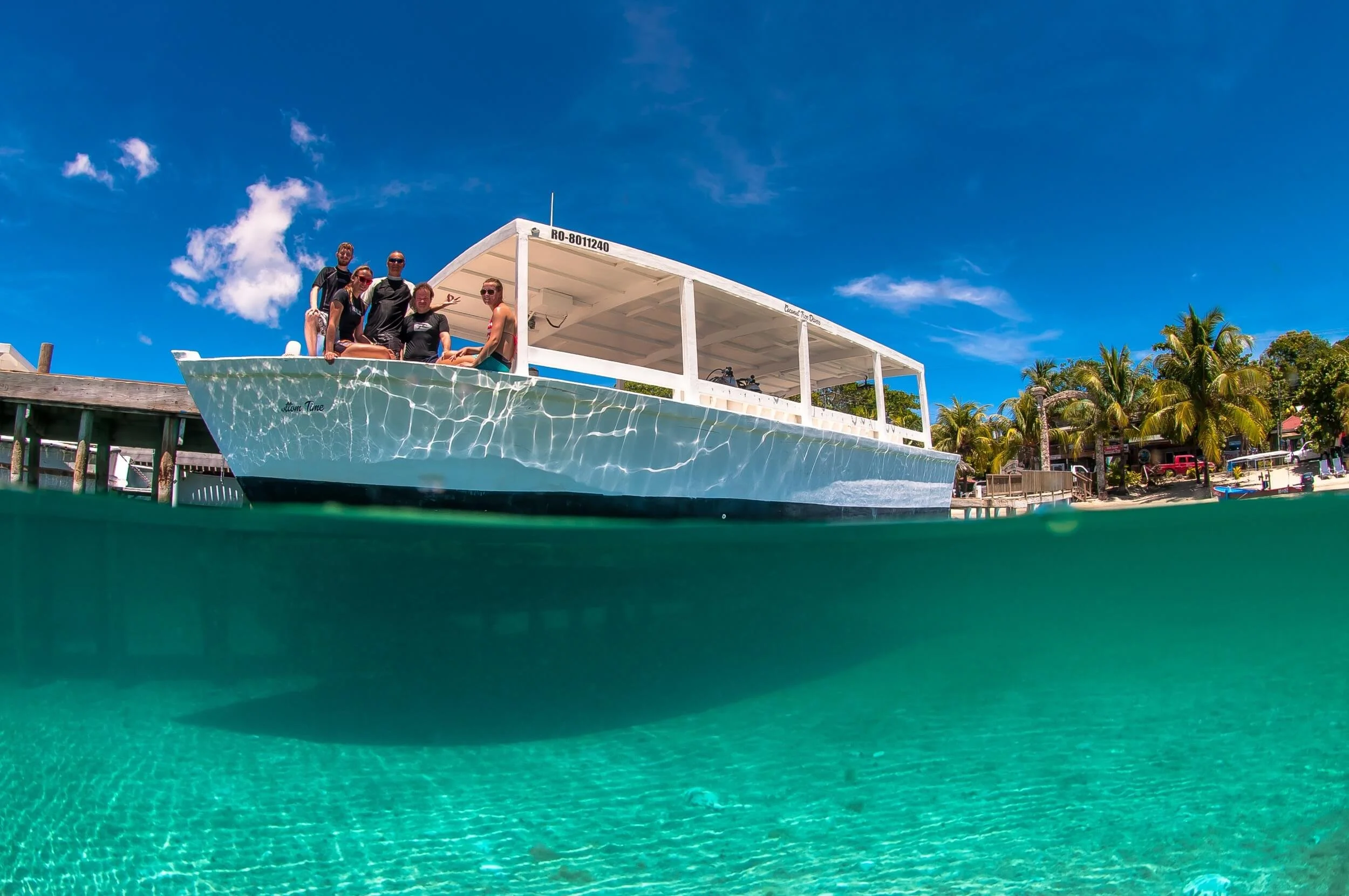
A Divemaster Internship is the most complete way to earn the PADI Divemaster qualification. At Go Pro Caribbean in Roatan you join the team from day one — learning on the job alongside experienced, full-time PADI instructors in a working dive centre. You do not follow a fixed timetable. You earn the qualification by doing the actual work, in real conditions, with real divers.
The Divemaster Internship runs for a recommended six weeks, with no upper limit. If you want ten or twelve weeks, that is fine — and welcome. If you have less time than six weeks, talk to us before you book and we will tell you honestly what is workable. Expect a full working week while you are with us — around 45 hours. Diving is unlimited throughout your time with us: the average trainee logs between 60 and 100 dives before qualifying. If you have not yet reached the 40-dive prerequisite, we will get you there at no extra cost before the formal course begins.
The PADI Divemaster is the first step into the professional ranks — the qualification Divemaster jobs ask for, and the foundation on which a diving career is built. Many of our Divemaster graduates go on to complete the IDC at the end of their Divemaster Internship, arriving at the course fit, dive-ready, and already comfortable with how a professional dive operation works. The complete PADI requirements every Divemaster Internship must satisfy, regardless of where you train, are set out in full below.
Divemaster and Master Scuba Diver sound alike, but they are different ratings. PADI Master Scuba Diver — the master diver rating — is the highest non-professional level in the PADI system: it recognises a Rescue Diver who has completed five PADI Specialty Diver courses and logged at least 50 dives, and it does not qualify a diver to lead or supervise other divers. The PADI Divemaster is the first professional level, the one that has you leading certified divers and assisting with scuba classes. If you want to dive for yourself, Master Scuba Diver is the top of that path; if you want to work in diving, the Divemaster is where the work begins. That is not to say that doing a Divemaster Internship is not for people who want to dive for themselves and do not plan to work in the industry. It is a great way to massively improve your dive skills and log lots of dives with unmatched value.
What that $1,050 covers, and what it does not. Our published prices are what Go Pro Caribbean charges for training and materials. PADI fees are paid directly to PADI, are identical wherever in the world you train, and are listed separately here so you can see the true total before you book.
- Divemaster training and materials, entering as a certified PADI Rescue Diver $1,050
- PADI Divemaster application Required $168
- All-in, entering as a PADI Rescue Diver $1,218
Starting from a lower certification level costs more, because the courses you still need are bundled into the package at a lower rate than they cost individually. All five Divemaster packages and their all-in totals are listed here → A private room is $10 per night, or $20 with air conditioning, four to six minutes' walk from the dive centre — and if you decide to go on and do your PADI IDC with us while you are here, that drops to $5 and $15 respectively, applied to your whole stay rather than just the IDC part of it. PADI fees are subject to change by PADI without notice.
Ready to look at prices? Browse Divemaster packages for every starting certification level — or message Will if six weeks does not fit your dates.
World Class Diving All year around
The nine PADI Divemaster course requirements in full
All PADI courses allow for flexibility — they need to be adapted to the local environment and to the individual student. No two Divemaster internships will be identical. But there is a standardised set of requirements that every candidate must meet, regardless of who delivers the training, where, or when. Those requirements are set out in full below.
1. Knowledge Development
- Complete knowledge development segments including Knowledge Reviews in the PADI Divemaster Manual or through Divemaster Online, and pass the Divemaster Final Exam.
- There are 8 Chapters and Knowledge Reviews.
- The Divemaster Exam is split into 2 parts, each 60 questions.
2. Emergency Assistance Plan
- Create an Emergency Assistance Plan for a designated dive site.
3. Water Skills Exercises
- Complete water-skills exercises, scoring at least 15 points total:
- 400 Yard Swim
- 800 Metre/Yard Swim
Swim 800 metres/yards face down, using mask, snorkel and fins, nonstop, without flotation aids and without using arms to swim.
Exceptions: A candidate with leg-use limitations, who normally arm-swims, may use arms.
Divemaster swim test times and scores — 800 metres and 800 yards 800 metres Score 800 yards under 14 min 5 under 13 min 14 to 16:30 min 4 13 to 15 min 16:30 to 18:30 min 3 15 to 17 min 18:30 to 21 min 2 17 to 19 min more than 21 min 1 more than 19 min stopped incomplete stopped - 15-Minute Tread
Tread water, drown-proof, bob or float using no aids and wearing only a swimsuit for 15 minutes, with hands (not arms) out of the water during the last two minutes.
Exceptions: A candidate with a physical impairment that makes it difficult/impossible to hold hands out of the water is exempted from that portion of the exercise with no effect on the score.
Score Criteria
- 5
- Performed satisfactorily
- 3
- Stayed afloat, but hands not out of water the entire two minutes
- 1
- Used side/bottom for momentary support no more than twice
- incomplete
- Used side/bottom for support more than twice
- 100 Metre/Yard Inert Diver Tow
Tow (or push) a diver for 100 metres/yards nonstop, at the surface, without assistance — both divers equipped in full scuba equipment.
Inert diver tow times and scores — 100 metres and 100 yards 100 metres Score 100 yards under 2:10 min 5 under 2 min 2:10 to 3:15 min 4 2 to 3 min 3:15 to 4:20 min 3 3 to 4 min 4:20 to 5:30 min 2 4 to 5 min more than 5:30 min 1 more than 5 min stopped incomplete stopped - Equipment Exchange
In confined water, demonstrate the ability to effectively respond to an unusual circumstance underwater by exchanging all scuba equipment (except exposure suits and weight belts) with a buddy while neutrally buoyant earning a minimum score of 3. During the exchange, when divers switch scuba kits, they should go to and breathe from their buddy's alternate air source, not the primary second stage. Instead of exchanging masks, divers remove and replace their own masks.
Conduct
- You and your buddy have less than five minutes to discuss the exercise.
- It is done in water too deep to stand in, without touching the bottom or breaking the surface.
- No problems are assigned, and you resolve any that arise naturally.
Score Criteria
- 5
- Task performed in a well-thought-out, efficient and purposeful manner with no sign of problems; very low anxiety level. Looks routine, easy and neither diver touched the bottom or the surface.
- 4
- Task performed competently with a relatively low anxiety level. Challenges encountered were easily and efficiently handled. Neither diver touched the bottom or the surface.
- 3
- Complete exchange occurred while neutrally buoyant. However, numerous challenges were encountered that delayed the speed and efficiency of the performance. This score is also appropriate for a diver overly dependent on another.
- 2
- Significant problems demonstrated, and exchange completed only after one or both team members surfaced once.
- 1
- Inability to complete the exchange; or exchange completed with one or both divers surfacing more than once.
4. Diver Rescue Assessment
- Complete a diver rescue assessment — respond to an unresponsive, nonbreathing diver, including these steps:
- Enter the water, locate and surface a submerged diver who is about 25 metres/yards away.
- Turn the diver face up and establish buoyancy.
- Remove the diver's mask and regulator, open the airway and check for breathing.
- Call for help.
- Give two initial rescue breaths, and continue with an effective rescue breath every five seconds with no or very few interruptions.
- Tow the diver to safety while protecting the airway, continuing rescue breathing.
- Remove both sets of equipment (equipment handlers allowed).
- Exit the water with the diver.
5. Dive Skills Workshop and Assessment
- Demonstrate all scuba and skin diving skills, scoring at least a 3 on each skill, and scoring at least 82 points total, with at least one underwater skill to a 5:
- 1. Equipment assembly, adjustment, preparation, donning and disassembly
- 2. Predive safety check (BWRAF)
- 3. Deep-water entry
- 4. Buoyancy check at surface
- 5. Snorkel–regulator / regulator–snorkel exchange
- 6. Five-point descent
- 7. Regulator recovery and clearing
- 8. Mask removal, replacement and clearing
- 9. Air depletion exercise and alternate air source use (stationary)
- 10. Alternate air source-assisted ascent
- 11. Free-flowing regulator breathing
- 12. Neutral buoyancy — using both oral and low pressure inflation
- 13. Five-point ascent
- 14. Controlled Emergency Swimming Ascent
- 15. Hover motionless for 30 seconds
- 16. Underwater swim without a mask
- 17. Remove and replace weight system underwater
- 18. Remove and replace scuba unit underwater
- 19. Remove and replace scuba unit on the surface
- 20. Remove and replace weight system on the surface
- 21. Vertical, head first skin dive
- 22. Swim at least 15 metres/50 feet underwater on a single breath while skin diving.
- 23. Snorkel clear using the blast method after ascending from a skin dive.
- 24. Snorkel clear using the displacement method after ascending from a skin dive.
6. Practical Application Skills
- Skill 1 — Dive Site Set Up and Management. Set up a dive site and manage predive preparation, including:
- Choosing a location appropriate for divers to assemble equipment.
- Preparing emergency equipment, such as a first aid kit and oxygen unit.
- Greeting divers as they arrive at the site/boat and providing direction.
- Organising a dive roster and reviewing check-in and check-out procedures with divers.
- Preparing and setting a float/dive flag if diving from shore, or ensuring the descent line and dive flag are ready when diving from a boat.
- Choosing an appropriate vantage point from which to monitor the dive.
- Being accessible to answer diver questions and prepared to assist divers both before and after the dive.
- Skill 2 — Mapping Project. Survey an open water dive site and create a detailed map showing (as applicable) underwater relief, points of interest, environmental notes, recommended entry/exit areas, local facilities and potential hazards.
- Skill 3 — Dive Briefing. Conduct a dive briefing for a familiar dive site covering all 10 points:
- 1. Dive site name
- 2. Site description
- 3. Your role and how divers can recognise you underwater
- 4. Entry and exit techniques
- 5. Dive procedures
- 6. Emergency procedures
- 7. Signal review specific to the dive
- 8. Roster and buddy check
- 9. Environmental orientation
- 10. Predive safety check
- Skill 4 — Search and Recovery Scenario:
- Demonstrate a methodical search of an area to find a small submerged object.
- Demonstrate a methodical search of an area to find a submerged object not more than 10 kg/25 lb negatively buoyant.
- Tie the following knots correctly underwater: the bowline, two half-hitches and a sheet bend.
- Demonstrate how to safely rig and bring to the surface an object not more than 10 kg/25 lb negatively buoyant using an appropriate lifting device.
- Skill 5 — Deep Dive Scenario:
- With a buddy before the dive, prepare emergency breathing equipment and position it at safety stop depth.
- Descend using a reference line, wall or sloping bottom as a visual guide only, while staying with a buddy and controlling the descent rate.
- Navigate with a compass at least 20 kick cycles away from and back to the reference line or designated spot.
- Use a depth gauge and timing device, or a dive computer, to monitor an ascent rate no faster than 18 metres/60 feet per minute.
- Perform a 3-minute safety stop at 5 metres/15 feet before surfacing without holding on to a reference line for positioning.
7. Divemaster-Conducted Programme Workshops
- Workshop 1: ReActivate Program
- Access ReActivate programme standards in the PADI Instructor Manual.
- State ReActivate knowledge assessment options.
- Demonstrate the prescriptive ReActivate method for determining skills to practise.
- Recognise and correct problems during skill practice.
- Workshop 2: Skin Diver Course and Snorkelling Supervision
- Give the Skin Diver course briefing or a snorkelling tour briefing.
- Conduct a Skin Diver course confined water or open water dive; or lead a snorkel tour, demonstrating control and supervision.
- Recognise and correct problems during the skin dive or snorkel tour.
- Workshop 3: Discover Scuba Diving — Confined Water
- Access Discover Scuba Diving programme standards in the PADI Instructor Manual and explain a divemaster's role as an assistant during a confined water experience.
- Locate the Discover Scuba Diving Leader Internship Requirements and explain how a divemaster qualifies as a Discover Scuba Diving Leader.
- Demonstrate proper positioning relative to participants as directed by the instructor.
- Recognise and correct problems during the experience.
- Workshop 4: Discover Scuba Diving — Additional Open Water Dive
- State the ratio and supervision requirements for an additional dive conducted by a PADI Divemaster.
- Give a dive briefing appropriate for Discover Scuba Diving participants for an additional open water dive.
- Lead the dive, demonstrating proper control and required supervision.
- Recognise and correct problems during the dive.
- Workshop 5: Discover Local Diving in Open Water
- Access Discover Local Diving programme standards in the PADI Instructor Manual.
- Assess dive site conditions and plan the dive.
- Give a Discover Local Diving briefing.
- Lead a dive, demonstrating control and supervision.
- Recognise and correct problems during the dive.
- Demonstrate how to deploy a surface marker.
8. Practical Assessments
- Practical Assessment 1 — Open Water Diver Students in Confined Water:
- Organise predive equipment setup by student divers.
- Coordinate student diver flow during training.
- Supervise student divers not receiving the immediate attention of the instructor.
- Help a student diver overcome a learning difficulty.
- Respond to, or prevent, student diver problems as they occur.
- Demonstrate a skill for student divers.
- Practical Assessment 2 — Open Water Diver Students in Open Water:
- Assess an open water training site; report to the instructor recommendations as to site suitability.
- Organise predive equipment setup by student divers.
- Assist in the preparation of the site.
- Coordinate student diver flow during training.
- Supervise student divers not receiving the immediate attention of the instructor.
- Respond to, or prevent, student diver problems as they occur.
- Lead student divers on an underwater tour (ratio 2:1).
- Practical Assessment 3 — Continuing Education Students in Open Water:
- Coordinate student diver flow during training.
- Escort continuing education student divers under indirect instructor supervision; report performance and learning difficulties to instructor.
- Help a continuing education student diver overcome a learning difficulty.
- Respond to, or prevent, student diver problems as they occur.
- Practical Assessment 4 — Certified Divers in Open Water:
- Conduct environmental and diver assessments, taking appropriate supervisory steps.
- Give a predive briefing appropriate to the dive site.
- Account for buddy teams entering and leaving the water.
- Respond to, or prevent, diver problems appropriately.
9. Professionalism Criteria
- Score at least a 3 in each category by the end of Practical Application:
- 1. Level of active, positive participation in training sessions.
- 2. Ability to serve as a mentor to student divers.
- 3. Willingness to follow directions.
- 4. Positive attitude and demeanour toward student divers, certified divers and staff.
- 5. Positive attitude and practice towards caring for the environment.
- 6. General understanding of a divemaster's role.
- 7. Appearance.
Those are the requirements — in full. How enjoyable the journey to meeting them can be depends entirely on where, when, and who you train with. Come and join us in Roatan and we will show you what they look like when they are actually fun.
Divemaster course questions, answered
What does the PADI Divemaster course involve?
The PADI Divemaster course involves knowledge development across eight chapters with a final exam, water skills exercises, a diver rescue assessment, a 24-skill dive skills workshop, five practical application skills, five divemaster-conducted programme workshops, four practical assessments, and professionalism criteria. All requirements are standardised by PADI regardless of where you train.
What water skills are required for the PADI Divemaster?
Candidates must complete a 400-yard swim, an 800-metre/yard swim, a 15-minute tread, a 100-metre/yard inert diver tow, and an underwater equipment exchange, scoring at least 15 points total.
How long does it take to become a PADI Divemaster?
Six weeks is the recommended duration, and there is no upper limit. Candidates who wish to take eight, ten, or twelve weeks are welcome. If you need to finish in less time than that, talk to us before you book and we will tell you honestly what is workable. Expect a full working week while you are with us — around 45 hours. Diving is unlimited throughout. The average trainee at Go Pro Caribbean logs between 60 and 100 dives before qualifying.
What are the prerequisites to start the PADI Divemaster course?
You must hold a PADI Advanced Open Water Diver certification or equivalent, a PADI Rescue Diver certification or equivalent, an Emergency First Response (EFR) certification or equivalent, and a minimum of 40 logged dives. If you have not yet reached 40 dives, Go Pro Caribbean will help you log them at no extra cost before the course begins.
What practical assessments are required for the PADI Divemaster?
There are four practical assessments: assisting Open Water Diver students in confined water, assisting Open Water Diver students in open water, escorting continuing education students in open water under indirect instructor supervision, and supervising certified divers in open water.
What does the PADI Divemaster course cost at Go Pro Caribbean?
Entering as a certified PADI Rescue Diver, training and materials are $1,050. PADI fees are separate and paid directly to PADI: the Divemaster application is $168 and is required, bringing the all-in cost to $1,218. PADI fees are identical wherever in the world you train. Packages for every other starting certification level are listed on the Divemaster packages page.
How much does accommodation cost during the Divemaster course?
A private room is $10 per night, or $20 per night with air conditioning, four to six minutes' walk from the dive centre. If you decide to go on and do your PADI IDC with us while you are here, the room rate drops by $5 per night — $5 for a fan room, $15 with air conditioning — and that discount is applied to your whole stay, not only the IDC part of it.
Is the PADI Divemaster a stepping stone to becoming an instructor?
Yes. The PADI Divemaster is the first professional level in the PADI system and the prerequisite for the Instructor Development Course (IDC). Completing your Divemaster course with a centre that also runs regular IDCs — such as Go Pro Caribbean in Roatan — means you can move seamlessly from one to the other.
Does a PADI Divemaster certification expire?
No — a PADI Divemaster certification does not expire. What lapses is membership: to stay in active status as a PADI Divemaster, you renew your PADI membership each year, paying the annual fee and meeting any regional insurance requirements. If your membership lapses, you can renew and return; what PADI asks of you beyond that depends on how long you have been away, starting with a free Member Update Webinar and progressing to some form of retraining with a PADI instructor for longer periods of inactivity.

The Divemaster is a stepping stone, not a destination
Most people who train to Divemaster level are thinking about what comes next. The PADI Instructor Development Course is the natural next step — and training your Divemaster with a centre whose entire culture is built around producing excellent instructors gives you a real head start.
At Go Pro Caribbean, many Divemaster graduates extend their time with us directly into the IDC. They arrive at the course fit and dive-ready, already familiar with how the operation works and comfortable in the teaching environment. That preparation is hard to replicate any other way.
Go Pro Caribbean runs monthly IDCs in Roatan with a maximum of six candidates per course — small enough that Will knows every candidate's strengths and weaknesses from day one. Find out more about the IDC in Roatan →
Ready to start your Divemaster training in Roatan?
Every Divemaster package includes unlimited diving from day one. PADI fees are paid directly to PADI and are itemised further up this page. A private room is available from $10 per night, four to six minutes' walk from the dive centre — and it drops to $5 for your whole stay if you go on to do your IDC with us. No fixed start dates — you begin when you arrive, and if six weeks does not fit your dates, message Will and we will tell you what is workable.