
Dive Computers, Gauges & Equipment — PADI IDC / DM Study Notes
Equipment — Topics
Depth gauges
Capillary depth gauge
The capillary gauge is the most frequently examined depth gauge type — understand it thoroughly.
Because the markings are based on Boyle's Law, the depth increments get progressively smaller the deeper you go — the first 10 m / 33 ft takes up half the entire tube. Reading the gauge accurately becomes harder with depth.
The practical result: the gauge is already displaying theoretical depth, so you do not need to apply altitude conversion factors when planning with a capillary gauge. Your NDL lookup on the RDP uses the depth shown directly on the gauge.
Other depth gauge types
| Type | How it works | Notes |
|---|---|---|
| Oil-filled (Bourdon tube) | A spiral Bourdon tube inside the gauge tightens under pressure and moves the needle | Most common mechanical gauge; cheapest and best value |
| Diaphragm | A flexible diaphragm connects to the needle via rods, levers, and gears | Less common; more expensive but more accurate than oil-filled |
| Electronic (dive computer) | Electronic depth sensor, usually integrated into a bottom timer or full dive computer | Now the most common type; increasingly replacing standalone gauges |
Exposure suits
Wet suits — what provides the insulation?
Dry suits — argon as inflation gas
Technical divers using trimix (a gas mixture containing helium) cannot inflate their dry suit from their back gas. Helium is a very poor insulator — using trimix as dry suit inflation gas provides almost no thermal protection.
Standard air cannot be used as an alternative because it creates a risk of isobaric counterdiffusion — a form of skin decompression sickness. The solution is argon: an excellent insulator, no isobaric counterdiffusion risk, and low cost.
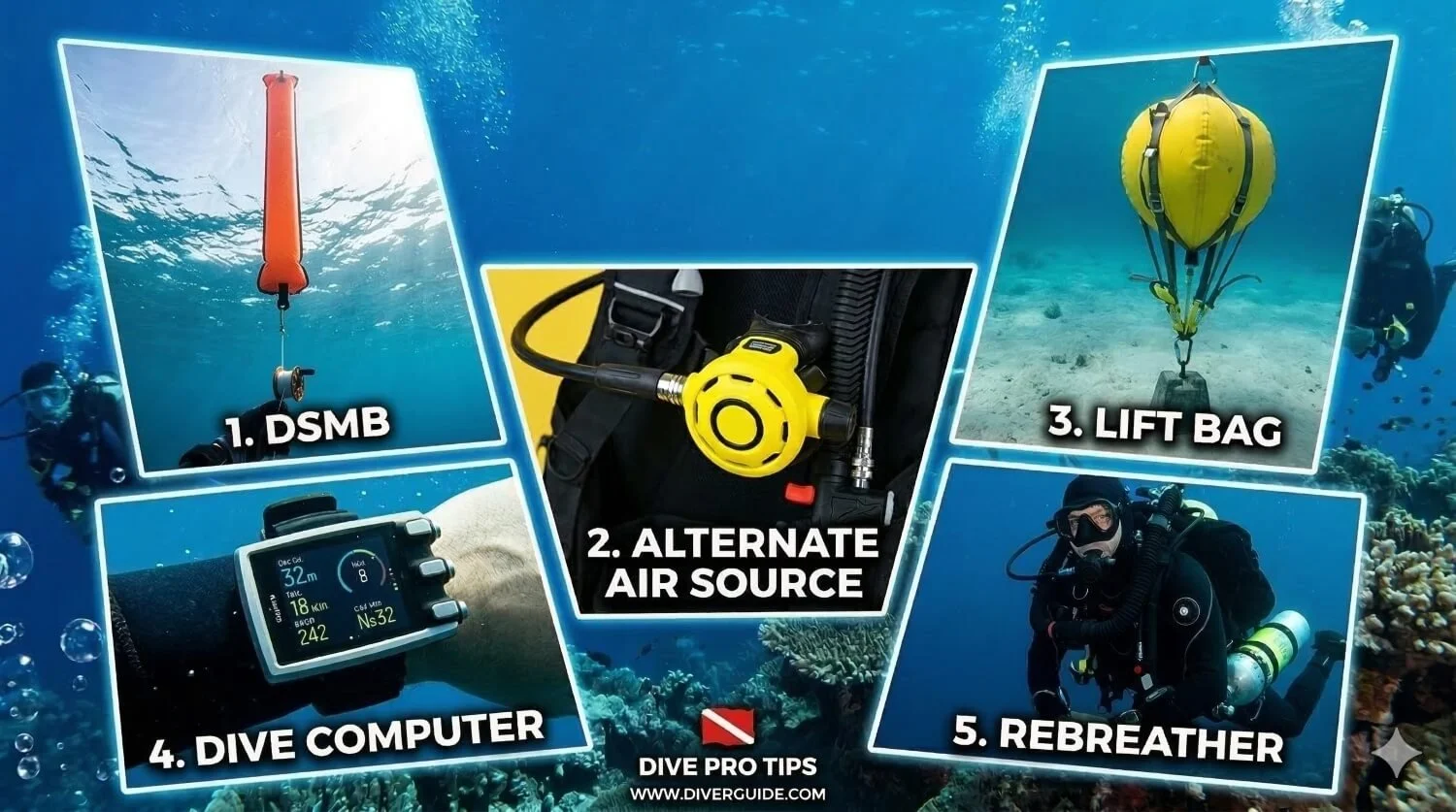
SMBs and DSMBs
| Type | Design features | Risk if released from depth |
|---|---|---|
| Open-bottom SMB | No valve — air added through open base | Air spills out on surfacing; may not remain inflated |
| Sealed SMB (one-way valve) | One-way valve prevents air escaping after inflation | No spill risk, but no over-pressure release — can burst or blow seams if over-inflated or released from depth |
| DSMB (delayed SMB) | Non-spill design plus over-pressure relief valve | Expanding air vents safely; air cannot escape back out — designed specifically for release from depth |
SMB / DSMB safety rules
- Always use a reel to manage the line when towing a DSMB or SMB — loose line is an entanglement hazard as you change depth
- Never attach an inflated SMB or DSMB to your BCD or D-ring — serious entanglement and uncontrolled ascent risk
Lift bags
| Rule | Weight / limit |
|---|---|
| Use a lift bag rather than lifting by hand | Object heavier than 7 kg / 15 lb |
| Maximum lift for recreational divers | 45 kg / 100 lb |
| Bag size to select | Slightly more lift capacity than the object's weight |
Alternate air source inflators
An alternate air source inflator combines the BCD inflator hose with a second regulator second stage. In an out-of-air emergency, the procedure differs from a standard octopus share:
Always identify your buddy's alternate air source type during the pre-dive buddy check so you know exactly what to expect if an emergency occurs.
Dive computers
Air-integrated computers
Nitrox and multi-gas computers
A nitrox or multi-gas computer tracks oxygen exposure based on the blend you are breathing and your current depth. It monitors your OTUs (oxygen tolerance units) using the oxygen clock, alerting you before you approach safe oxygen exposure limits. Essential for any diver using nitrox or mixed gases.
Closed-circuit rebreathers (CCR)
The two tanks
The breathing loop and CO2 scrubber
On open-circuit, exhaled gas goes into the water. On a rebreather, exhaled gas stays within a closed loop. It passes through a CO2 scrubber — a canister of chemical absorbent that removes CO2 — and is then recirculated back to the diver. The counter lungs are the flexible bags that hold this circulating gas.
Buoyancy control on a rebreather
As a result, rebreather divers control buoyancy almost entirely through BCD inflation and deflation, not breath control.
Electronics — oxygen sensor and depth sensor
The rebreather's electronics monitor two things continuously: the oxygen partial pressure in the breathing loop (via an oxygen sensor) and the current depth. Using these two values the unit always knows exactly what ppO2 the diver is being exposed to, allowing it to prevent oxygen toxicity automatically.
The set point — how the mix is adjusted
• ppO2 too low (e.g. after ascending) → inject oxygen into the loop
• ppO2 too high (e.g. after descending) → inject diluent (air or trimix) into the loop
Divers typically use a lower set point for the surface and descent phase, and a higher set point (commonly 1.3 atm) for the main portion of the dive.
Rebreather: gas ratio changes continuously to maintain a constant target oxygen partial pressure (the set point).

Equipment — Topics