
Moving between Depths — PADI IDC and Divemaster Theory

Will Welbourn introduces depth-to-depth calculations and the 3-step-twice method — PADI IDC and Divemaster physics exam study notes.
Depth-to-Depth Calculations
Depth-to-depth questions are the trickiest calculation type in the PADI physics exam — but only because most students don’t realise they can use the exact same 3-step method, just twice. Once you see that, these questions are no harder than the ones you already know how to answer.
Step one: go from the first depth up to the surface.
Step two: go from the surface down to the second depth.
Two rounds of the same 3-step process. That’s it.
The 3-Step-Twice Method
The method works the same way for any quantity that changes with depth — balloon volume, minutes of air, PSI consumption, density. The logic is always the same: treat the surface as your midpoint.
- Step 1: Write down the starting value given in the question.
- Step 2: Multiply or divide? Think about what happens as the object rises to the surface. Balloons get bigger → multiply. Air lasts longer at the surface → multiply. Denser air at depth means you breathe through more PSI per minute → divide.
- Step 3: Find the pressure at the first (starting) depth and apply it. This gives you the surface value.
- Step 1: Write down the surface value you just calculated in Round 1.
- Step 2: Multiply or divide? Now think about what happens as the object descends to the second depth. Going deeper is the reverse of Round 1.
- Step 3: Find the pressure at the second depth and apply it. This is your final answer.

Will Welbourn works through depth-to-depth example 1 — balloon volume moving between two depths.
Worked Example 1 — Balloon Volume
This is the first depth-to-depth worked example. The question gives a balloon volume at a starting depth and asks for the volume at a different depth — neither of which is the surface. Use the 3-step method twice.
- Step 1 — Starting value: The answers are in litres, so find litres in the question. The balloon holds 9 litres at 20 m.
- Step 2 — Multiply or divide? The balloon is rising from 20 m to the surface. Balloons get bigger as they ascend — so multiply.
- Step 3 — Pressure at the starting depth: Pressure at 20 m = 3 atm. 9 × 3 = 27 litres at the surface.
- Step 1 — Starting value: Take the surface result from Round 1. The balloon is now 27 litres at the surface.
- Step 2 — Multiply or divide? The balloon is descending from the surface to 10 m. Balloons get smaller as they descend — so divide.
- Step 3 — Pressure at the second depth: Pressure at 10 m = 2 atm. 27 ÷ 2 = 13.5 litres.

Will Welbourn works through depth-to-depth example 2 — air consumption in minutes.
Worked Example 2 — Air Consumption in Minutes
This example uses minutes instead of litres, but the method is identical. The key is getting the multiply/divide decision right for each round — and remembering that the logic flips between Round 1 and Round 2.
- Step 1 — Starting value: The answers are in minutes, so find minutes in the question. The tank lasts 45 minutes at 5 m.
- Step 2 — Multiply or divide? Going from 5 m to the surface. Air lasts longer at the surface than at depth, because the air is less dense there. More minutes means a bigger number — so multiply.
- Step 3 — Pressure at the starting depth: Pressure at 5 m = 1.5 atm. 45 × 1.5 = 67.5 minutes at the surface.
- Step 1 — Starting value: Take the surface result from Round 1. The tank would last 67.5 minutes at the surface.
- Step 2 — Multiply or divide? Going from the surface down to 35 m. The tank lasts less time at depth — fewer minutes means a smaller number — so divide.
- Step 3 — Pressure at the second depth: Pressure at 35 m = 4.5 atm. 67.5 ÷ 4.5 = 15 minutes.

Will Welbourn works through depth-to-depth example 3 — PSI air consumption rate.
Worked Example 3 — PSI Air Consumption
PSI questions follow exactly the same pattern. The only difference from minutes is that the multiply/divide logic in Round 1 is reversed — because PSI per minute measures how fast you breathe through air, not how long it lasts.
- Step 1 — Starting value: The answers are in PSI, so find PSI in the question. The diver breathes through 10 PSI per minute at 50 m.
- Step 2 — Multiply or divide? Going from 50 m to the surface. At the surface, air is less dense, so the diver breathes through less PSI per minute — a smaller number — so divide.
- Step 3 — Pressure at the starting depth: Pressure at 50 m = 6 atm. 10 ÷ 6 = 1.6̅ PSI per minute at the surface.
- Step 1 — Starting value: Take the surface result from Round 1. The diver consumes 1.6̅ PSI per minute at the surface.
- Step 2 — Multiply or divide? Going from the surface down to 20 m. At depth, air is denser, so the diver breathes through more PSI per minute — a bigger number — so multiply.
- Step 3 — Pressure at the second depth: Pressure at 20 m = 3 atm. 1.6̅ × 3 = 5 PSI per minute.
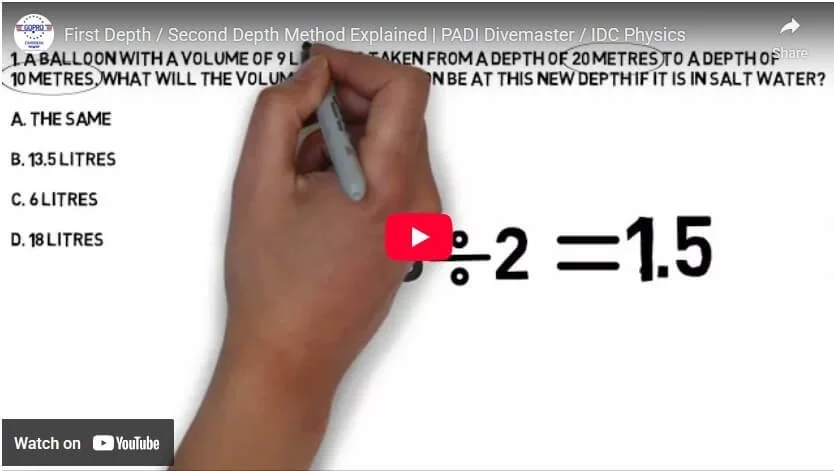
Introduction to the first depth / second depth method — an alternative approach to depth-to-depth calculation questions.
Alternative Method — First Depth / Second Depth
The 3-step-twice method works for every depth-to-depth question. But there is a faster shortcut that some candidates prefer, especially when the answers include fractions. It gives the same correct answer — it is simply a different route to get there.
Change factor = pressure at first (starting) depth ÷ pressure at second (ending) depth
Then apply that change factor to the starting value. Ask yourself: does the quantity get bigger or smaller as it moves from the first depth to the second depth? Multiply if it gets bigger. Divide if it gets smaller.
The division is always the same — first depth pressure over second depth pressure. The only judgement call is what to do with the result.
A balloon holds 9 litres at 20 m. What is its volume at 10 m in salt water?
- Find the change factor: Pressure at 20 m (first depth) = 3 atm. Pressure at 10 m (second depth) = 2 atm. Change factor = 3 ÷ 2 = 1.5.
- Apply to starting value: Starting volume = 9 litres. The balloon is ascending (20 m → 10 m), so it gets bigger — multiply. 9 × 1.5 = 13.5 litres.
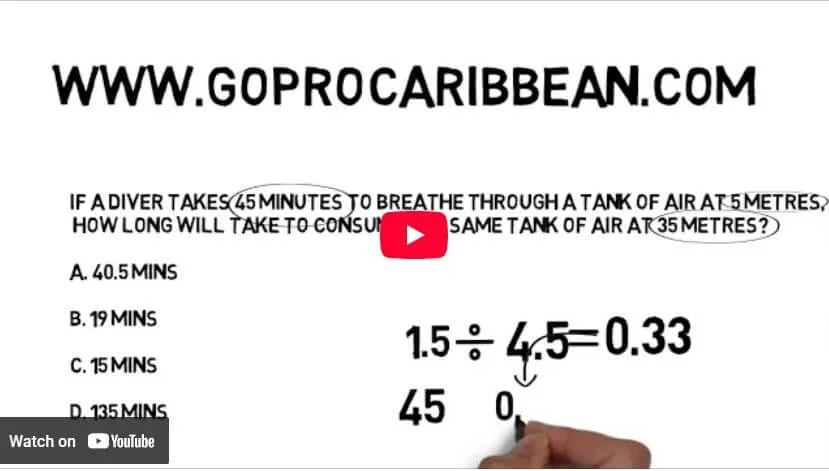
First depth / second depth method applied to a minutes question — including the important trap when the change factor is less than 1.
Example 2 — Air Consumption in Minutes
The change factor is straightforward to calculate, but what you do with it depends on whether it is greater or less than 1. This example introduces that trap clearly.
A diver takes 45 minutes to breathe through a tank at 5 m. How long will the same tank last at 35 m in salt water?
- Find the change factor: Pressure at 5 m (first depth) = 1.5 atm. Pressure at 35 m (second depth) = 4.5 atm. Change factor = 1.5 ÷ 4.5 = 0.33.
- Apply to starting value: Starting time = 45 minutes. The diver is descending (5 m → 35 m), so air runs out faster — the answer must be less than 45.
When the change factor is less than 1: multiply to make the value smaller, divide to make it bigger — the reverse of normal intuition.
The safest habit is to check your answer makes sense before moving on. A diver going from 5 m to 35 m must use air faster, so the answer must be less than 45 minutes. If your calculation gives a larger number, you have multiplied when you should have divided, or vice versa.
The 3-step-twice method avoids this trap entirely, because you always end up with pressures greater than 1.
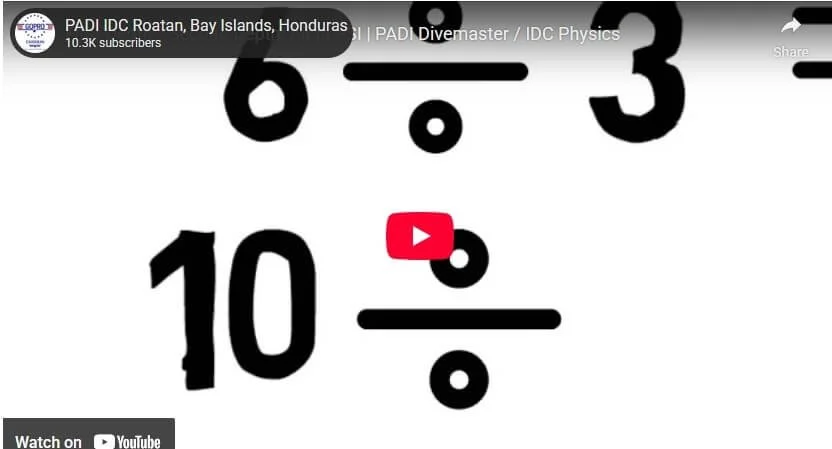
First depth / second depth method applied to a PSI air consumption question — an example where the change factor is greater than 1.
Example 3 — Air Consumption in PSI
This example uses the same PSI question from Worked Example 3. The change factor comes out greater than 1 here, so the multiply/divide logic is straightforward.
A diver consumes 10 PSI per minute at 50 m. How many PSI per minute will they consume at 20 m in salt water?
- Find the change factor: Pressure at 50 m (first depth) = 6 atm. Pressure at 20 m (second depth) = 3 atm. Change factor = 6 ÷ 3 = 2.
- Apply to starting value: Starting PSI rate = 10 PSI/min. The diver is ascending (50 m → 20 m), so they breathe through less PSI per minute — the answer must be less than 10. To make 10 smaller using 2, divide. 10 ÷ 2 = 5 PSI/min.
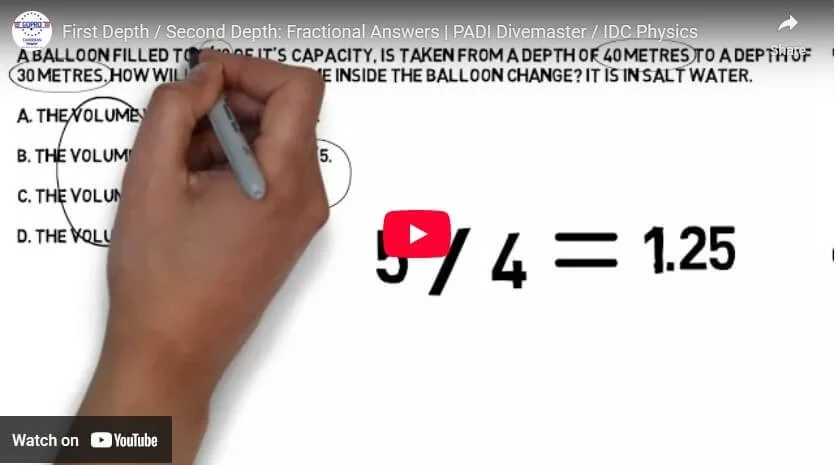
First depth / second depth method — the fractional answers shortcut that makes this method especially useful in the PADI physics exam.
Example 4 — Where This Method Really Earns Its Place
Some exam questions give fractional starting values and fractional answer choices. The 3-step-twice method still works, but the first depth / second depth method can give you the answer before you even finish the calculation.
A balloon has a volume of 1/10 of a litre at 40 m. What will its volume be at 30 m in salt water?
- Find the change factor — write it as a fraction: Pressure at 40 m (first depth) = 5 atm. Pressure at 30 m (second depth) = 4 atm. Change factor = 5/4. Write it as a fraction, not a decimal.
- Check the answer choices: The balloon is ascending (40 m → 30 m), so its volume increases. Look at the answers — if you see an option that says the volume increases by a factor of 5/4, that is your answer. No further arithmetic required.
If none of the answers contains your fraction, convert to a decimal and complete the calculation normally.
Physics Quick Quiz 2
Depth-to-depth calculations • 3-step-twice method