
Partial Pressure — PADI IDC and Divemaster Theory

Will Welbourn introduces partial pressure, Dalton's Law, contaminated tank question types, altitude, and the 3-step method for the PADI Divemaster and IDC physics exam.
Partial pressure questions are among the most straightforward calculations in the PADI physics exam — once you know the single rule that applies to all of them. Unlike Boyle's Law questions, where you have to stop and decide whether to multiply or divide, partial pressure questions have no decision. Like density, the operation is fixed every time. With density you always divide. With partial pressure you always multiply. Understanding why makes the rule impossible to forget.
Dalton's Law
At sea level, the total pressure is 1 ata. Air is made up of approximately 21% oxygen and 79% nitrogen. So the partial pressure of oxygen in air at sea level is 0.21 ata, and the partial pressure of nitrogen is 0.79 ata. They add up to 1 ata — the total pressure.
As a diver goes deeper, total pressure increases. Because each gas still makes up the same percentage of the mix, each gas's partial pressure increases in direct proportion to the total pressure. At 10m (2 ata), the partial pressure of oxygen in air is 0.42 ata. At 20m (3 ata), it is 0.63 ata. The percentage stays fixed; the total pressure drives the partial pressure up.
Gas percentages to know
PADI exam questions always use the same assumed gas compositions. You must know these without looking them up.
| Gas | Blend | Percentage | Decimal (Step 1) |
|---|---|---|---|
| Oxygen | Air | 21% | 0.21 |
| Nitrogen | Air | 79% | 0.79 |
| Oxygen | Nitrox 32 | 32% | 0.32 |
| Oxygen | Nitrox 36 | 36% | 0.36 |
The 3-step method
Step 2 — Always multiply. No decision needed.
Step 3 — Write down the total pressure at the depth given. If the question gives a pressure directly, use that number. If it gives a depth, convert it to ata first.
Partial pressure is determined by two things: the fraction of the gas in the mix, and the total pressure that mix is under. Multiplying them together gives the share of the total pressure that belongs to that gas. This is why you always multiply — it is not a rule to memorise, it is the definition of what partial pressure means.
Concept topics from the introductory video
The video above covers several concept questions that appear in the PADI physics exam alongside the calculation questions. These do not require a calculator — they test whether you understand how partial pressure behaves in specific situations.
Contaminated tanks
If a compressed gas tank contains a contaminant such as carbon monoxide, its partial pressure increases with depth just as any other gas does. A contamination level within acceptable limits at the surface can become dangerously toxic at depth. This is why diving gas purity standards are stricter than for surface use, and why tanks must be filled from a clean, properly maintained compressor.
Contaminated tank questions are among the most frequently misread questions in the PADI physics exam. Read the three questions below carefully. They describe exactly the same scenario — a cylinder containing 0.5% carbon monoxide taken to 40m — but each asks for something different. Before reading on, think about what each question is actually asking for. The explanation follows.
a) 0.5% b) 1.0% c) 2.0% d) 2.5%
a) 0.5% b) 2.0% c) 2.5% d) 0.1%
a) 0.025 ata b) 0.020 ata c) 0.05 ata d) 0.25 ata
a) 0.5% b) 2.0% c) 2.5% d) 0.1%
| Question type | Trigger phrase to spot | What to do |
|---|---|---|
| Composition inside the cylinder | in the tank / in the cylinder | Nothing — composition does not change with depth. The answer is the same percentage as at the surface. |
| Surface equivalent percentage | surface equivalent percentage / same effect as breathing ___% at the surface | 3-step multiply. Express your answer as a percentage. |
| Partial pressure in ata | partial pressure | 3-step multiply. Express your answer in ata. |
- Spot the trigger: in the cylinder — composition inside a sealed container. No calculation needed.
- Composition does not change with depth.
- Spot the trigger: effect — surface equivalent percentage. Multiply, express answer as a percentage.
- Step 1 — 0.5% as a decimal = 0.005
- Step 2 — always multiply: 0.005 × …
- Step 3 — pressure at 40m salt water = 5 ata
0.005 × 5 = 0.025 → as a percentage = 2.5%
- Spot the trigger: partial pressure — multiply, express answer in ata.
- Step 1 — 0.5% as a decimal = 0.005
- Step 2 — always multiply: 0.005 × …
- Step 3 — pressure at 40m salt water = 5 ata
0.005 × 5 = 0.025 ata
- Spot the trigger: surface equivalent percentage — multiply, express answer as a percentage.
- Step 1 — 0.5% as a decimal = 0.005
- Step 2 — always multiply: 0.005 × …
- Step 3 — pressure at 40m salt water = 5 ata
0.005 × 5 = 0.025 → as a percentage = 2.5%
Open liquid-filled containers
Gases dissolve into liquids under pressure — the greater the pressure, the more gas goes into solution (Henry's Law). When pressure decreases, dissolved gas comes back out of solution. An open liquid-filled container brought up from depth will release dissolved gas as the surrounding pressure drops. This same principle underlies decompression sickness: nitrogen dissolves into body tissues under pressure and must be allowed to come out slowly during ascent.
Gas containers at depth
A sealed, rigid gas container — such as a scuba cylinder — does not change the amount of gas it holds as depth increases. The total amount of gas is fixed; only the surrounding water pressure changes. What does change is the pressure differential between the gas inside and the water outside, which is why cylinders are rated to specific working pressures.
Altitude
At altitude, atmospheric pressure at the surface is lower than 1 ata. This means the partial pressures of all gases in the air are lower than at sea level. A diver breathing air at altitude is breathing air with a lower partial pressure of oxygen — not because the percentage has changed (it is still 21%), but because the total pressure is lower. This affects decompression calculations and is the basis of altitude diving procedures.
Worked examples
Partial pressure questions in the PADI exam take one of two forms: a depth is given and you convert it to pressure, or a pressure is given directly and you use it straight away. The four examples below cover both forms and introduce nitrox, so every question type you will see on the paper is represented.

Will Welbourn works through partial pressure example 1 — the partial pressure of oxygen in air at 20m.
- Target gas: oxygen in air → write down 0.21
- Partial pressure question → always multiply: 0.21 × …
- Depth: 20m in salt water → pressure = 3 ata
0.21 × 3 = 0.63 ata

Will Welbourn works through partial pressure example 2 — the partial pressure of nitrogen in air at 15m.
- Target gas: nitrogen in air → write down 0.79
- Partial pressure question → always multiply: 0.79 × …
- Depth: 15m in salt water → pressure = 2.5 ata
0.79 × 2.5 = 1.975 ata

Will Welbourn works through partial pressure example 3 — PPO2 when breathing Nitrox 32 at 33m.
- Target gas: oxygen in Nitrox 32 → write down 0.32
- Partial pressure question → always multiply: 0.32 × …
- Depth: 33m in salt water → pressure = 4.3 ata
0.32 × 4.3 = 1.376 ata

Will Welbourn works through partial pressure example 4 — PPO2 at altitude where the ambient pressure is given directly rather than derived from a depth.
- Target gas: oxygen in air → write down 0.21
- Partial pressure question → always multiply: 0.21 × …
- Pressure is given directly: 0.8 ata — no depth conversion needed
0.21 × 0.8 = 0.168 ata
Harder question types
The following questions require the same 3-step approach but with small additional layers that catch unprepared candidates. Read each question carefully before attempting it.
Enriched air — both percentages given
In diving, the terms "nitrox," "enriched air," and "enriched air nitrox" are used interchangeably to describe any breathing gas with a higher oxygen percentage than air. For exam purposes, treat them as identical. The question below gives you both gas percentages — only one is needed.
a) 1.05 ata b) 0.90 ata c) 1.20 ata d) 0.105 ata
- The question asks for the partial pressure of oxygen. Oxygen is 30% of the blend → write down 0.30. Ignore the 70% nitrogen figure — it is not needed.
- Partial pressure question → always multiply: 0.30 × …
- Depth: 25m in salt water → pressure = 3.5 ata
0.30 × 3.5 = 1.05 ata
Reverse partial pressure — finding the depth
Every question up to this point has given you a depth and asked you to find a partial pressure. This question type works the other way: it gives you a target partial pressure and asks you to find the depth at which it is reached. The method is still 3-step, but Step 2 becomes a division rather than a multiplication — the one exception on this page.
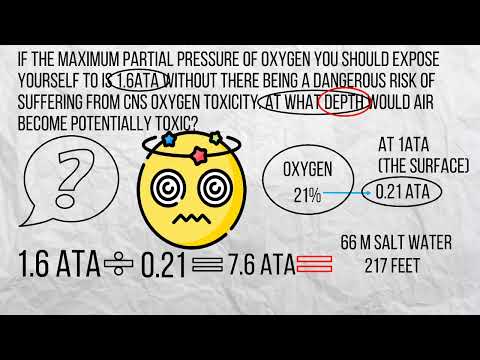
Will Welbourn works through the reverse partial pressure question — at what depth would breathing air reach the 1.6 ata CNS oxygen toxicity limit.
- Target gas: oxygen in air → write down 0.21
- Target PPO2 is given → divide: 1.6 ÷ 0.21 = 7.619 ata — this is the total pressure at which the limit is reached
- Convert pressure to depth: 7.619 ata in salt water → subtract 1, multiply by 10 → (7.619 − 1) × 10 = approximately 66m
- Target gas: oxygen in EANx 33 → write down 0.33
- Target PPO2: pure oxygen at the surface = 1.0 ata → divide: 1.0 ÷ 0.33 = 3.03 ata
- Convert pressure to depth: 3.03 ata → (3.03 − 1) × 10 = approximately 20m
Physics Practice — Partial Pressure
8 questions — covers all question types on this page