
How to Use the PADI RDP Table — All Five Question Types with Worked Examples
Every RDP Table question follows the same process: draw a dive diagram, fill in the numbers from the question, then work left to right through the diagram using the tables. That methodical approach is what avoids the small errors that cost marks in exams.
The RDP Table and the eRDPml: what is different
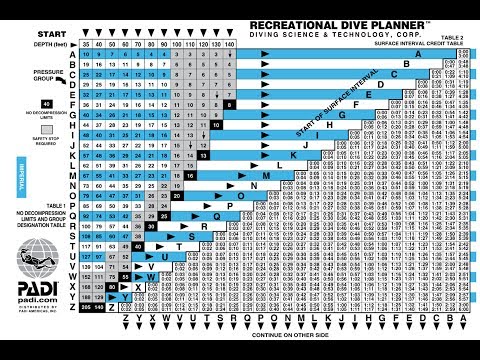
The RDP Table and the eRDPml answer the same types of question, but they often produce different results. The table has fewer depth columns — 35ft, 40ft, 50ft, 60ft, and so on in larger steps. The eRDPml uses five-foot increments (35ft, 40ft, 45ft, 50ft, 55ft and so on), so there is far less rounding involved. Because the table has gaps between its columns, you must always round your depth or time up to the next value available. The result is that the table tends to give more conservative answers — shorter no-decompression limits, higher pressure groups, and longer required surface intervals on some dives.
The table has three sections. Table 1 gives no-decompression limits and pressure group designations for single dives. The Surface Interval Credit Table (on the same side as Table 1) lets you find your new pressure group after a surface interval. Table 2 handles repetitive dives — it gives you the residual nitrogen time (RNT) and the adjusted no-decompression limit (ANDL) for a given starting pressure group and planned depth.
ABT, RNT, and TBT — the most important distinction on table questions
When using the RDP Table on any dive after the first, you must account for the nitrogen already in your body from the previous dive. The table uses three time values to do this. Confusing them is the single most common source of error on exam questions.
ABT — Actual Bottom Time. The time you plan to spend at depth on a given dive. This is the dive time given in the question.
RNT — Residual Nitrogen Time. A number of minutes representing the nitrogen already in your body from a previous dive. You read this from Table 2 at the intersection of your starting pressure group and your planned depth. It is the number that appears to be above water — the upper (white) number in the cell.
TBT — Total Bottom Time. ABT + RNT. This is the number you use when looking up your ending pressure group in Table 1. On any repetitive dive, always use TBT, not ABT, when finding your ending pressure group.
The eRDPml calculates ABT, RNT, and TBT for you automatically. When using the paper table, you must do this calculation yourself. On your dive diagram, always write the given dive time next to ABT — not next to TBT — as a reminder that TBT still needs to be calculated before you can look up the ending pressure group.
Calculating your pressure group after a series of dives
This question type asks you to track pressure groups across multiple dives and surface intervals. Work through the diagram one step at a time. The key trap is on any dive after the first: you must calculate TBT and use that value — not ABT — to find the ending pressure group in Table 1.
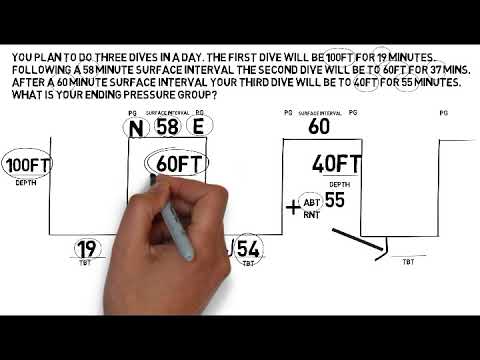
Video: Calculating pressure groups after a series of dives — worked example
Three dives in one day. Dive 1: 100ft for 19 minutes. Surface interval: 58 minutes. Dive 2: 60ft, ABT 37 minutes. Surface interval: 60 minutes. Dive 3: 40ft, ABT 55 minutes. What is the ending pressure group after the third dive?
Dive 1 — Table 1: 100ft column, 19 minutes → pressure group N.
Surface interval 1 — SI credit table: Starting pressure group N, surface interval 58 minutes. The 58-minute SI falls within the 52–59 minute range → pressure group E.
Dive 2 — find RNT in Table 2: Pressure group E / 60ft. The upper (white) number at that intersection is the RNT = 17 minutes. TBT = 37 (ABT) + 17 (RNT) = 54 minutes.
Dive 2 — Table 1: 60ft column, TBT 54 minutes → pressure group V.
Surface interval 2 — SI credit table: Starting pressure group V, surface interval 60 minutes. The 60-minute SI falls within the 1:00–1:05 range → pressure group H.
Dive 3 — find RNT in Table 2: Pressure group H / 40ft. Upper (white) number = RNT = 37 minutes. TBT = 55 (ABT) + 37 (RNT) = 92 minutes.
Dive 3 — Table 1: 40ft column, TBT 92 minutes. The table shows 91, then jumps to 97 — round up to 97 minutes → pressure group U.
Answer: Pressure group U.
Finding the minimum surface interval between two dives
This question gives you both dives and asks how long you must surface between them. Work backwards: first find what pressure group you need to start the second dive in (look at the blue, ANDL numbers in Table 2 for the second dive depth and planned time), then use the SI credit table to find how long a surface interval takes you from your ending pressure group after the first dive to that required starting pressure group.
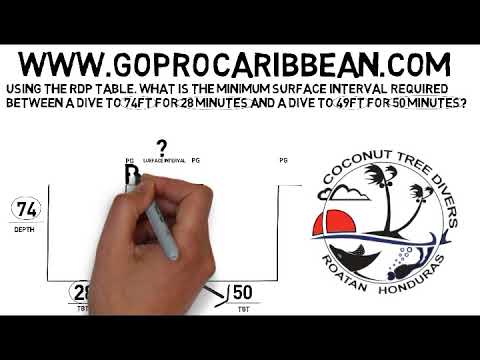
Video: Finding the minimum surface interval between two dives — worked example
Dive 1: 74ft for 28 minutes. Dive 2: 49ft for 50 minutes. What is the minimum surface interval?
Dive 1 — Table 1: 74ft is not in the table — round up to 80ft. 80ft / 28 minutes → pressure group P.
Second dive depth: 49ft is not in the table — round up to 50ft.
Find required starting pressure group — Table 2: In the 50ft column, look at the blue (underwater) numbers — these are your ANDL values. You need an ANDL of at least 50 minutes. The values jump from 48 to 52. The 48-minute option is not enough, so you need the pressure group that gives 52 minutes: pressure group H.
Find minimum SI — SI credit table: You end the first dive in pressure group P. You need to reach pressure group H. Find the intersection of those two rows. The range shown is 39–45 minutes, so the minimum surface interval is the lower number: 39 minutes.
Answer: Minimum surface interval = 39 minutes.
Finding the adjusted no-decompression limit for a repetitive dive
This question gives you a first dive, a surface interval, and the depth of a planned second dive, and asks how long you can stay at that depth. The answer is the ANDL — the number that appears to be underwater when you look at Table 2. That is the lower (blue) number in the cell at the intersection of your starting pressure group and your planned depth.
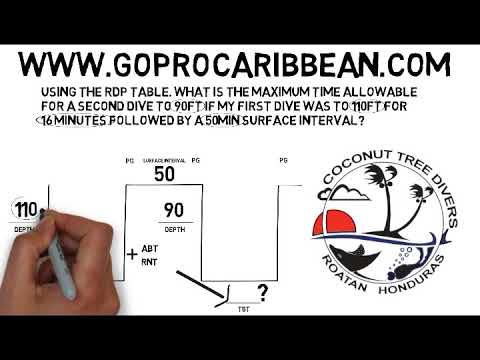
Video: Finding the adjusted no-decompression limit — worked example
Dive 1: 110ft for 16 minutes. Surface interval: 50 minutes. Dive 2: 90ft. What is the adjusted no-decompression limit?
Dive 1 — Table 1: 110ft / 16 minutes → pressure group M.
Surface interval — SI credit table: Starting pressure group M, 50 minutes. The 50-minute SI falls within the 47–55 minute range → pressure group E.
Find ANDL — Table 2: Pressure group E / 90ft. The cell at that intersection contains two numbers. The lower number — the one that appears to be underwater — is your ANDL: 14 minutes.
Answer: Adjusted no-decompression limit = 14 minutes.
The upper number in the same cell (11 minutes in this example) is your RNT. That is the nitrogen credit from your first dive. It is not the answer to this question.
Finding the maximum allowable depth for a repetitive dive
This question gives you a first dive, a surface interval, and a planned bottom time for the second dive, and asks for the maximum depth. Table 2 will give you one answer based on nitrogen alone — but RDP Rule 9 may give you a shallower answer that overrides it. Always apply Rule 9 as a final check.
Video: Finding the maximum allowable depth — Rule 9 trap explained
Dive 1: 41ft for 45 minutes. Surface interval: 2 hours. Dive 2: planned bottom time 63 minutes. What is the maximum allowable depth?
Dive 1 — Table 1: 41ft is not in the table — round up to 50ft. At 50ft, 45 minutes is not in the table — round up to 47 minutes → pressure group O.
Surface interval — SI credit table: Starting pressure group O, 2 hours. The 2-hour SI falls within the 1:35–2:23 range → pressure group B.
Find max depth — Table 2: In the pressure group B row, find the shallowest depth at which the ANDL is at least 63 minutes. The 50ft column shows 67 minutes — sufficient for a 63-minute dive. Nitrogen alone suggests a maximum depth of 50ft.
Apply Rule 9: The first dive was to 41ft. No subsequent dive may be deeper than 41ft. 50ft exceeds 41ft, so Rule 9 limits the second dive to 41ft.
Answer: Maximum allowable depth = 41ft.
Calculating the total time to complete three dives with minimum surface intervals
This is the most complex question type. Work backwards from each dive after the first to find the minimum required starting pressure group, and therefore the minimum surface interval. As you go, note whether a safety stop is required on each dive (a grey or black box in Table 1 means a safety stop is required). When totalling the series, use ABT for each dive — not TBT. Add each safety stop (3 minutes) and each surface interval.
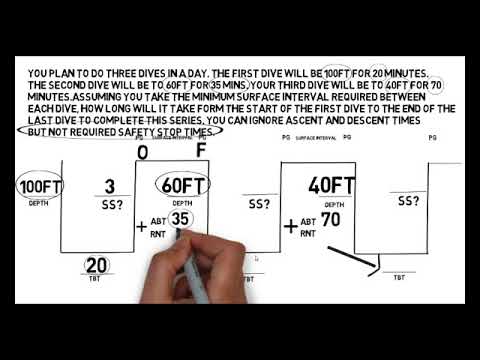
Video: Total time for three dives with minimum surface intervals — worked example
Dive 1: 100ft for 20 minutes. Dive 2: 60ft for 35 minutes. Dive 3: 40ft for 70 minutes. Taking the minimum surface interval between each dive, including all required safety stops, how long does the complete series take?
Dive 1 — Table 1: 100ft / 20 minutes → pressure group O. This falls in a grey box → 3-minute safety stop required.
Work backwards from Dive 2: Dive 2 is 60ft for 35 minutes ABT. In the 60ft column of Table 2, find the shallowest pressure group with an ANDL of at least 35 minutes. The blue number for that row is 36 minutes → pressure group F. Note the RNT at pressure group F / 60ft = 19 minutes (needed shortly). TBT on Dive 2 = 35 + 19 = 54 minutes.
Minimum SI 1 — SI credit table: Starting pressure group O, need to reach pressure group F. Minimum SI = 48 minutes.
Dive 2 ending PG — Table 1: 60ft / TBT 54 minutes → pressure group V. Grey box → 3-minute safety stop required.
Work backwards from Dive 3: Dive 3 is 40ft for 70 minutes ABT. Round 70 up to 71 minutes in Table 2. The pressure group with an ANDL of at least 71 minutes at 40ft is pressure group P. RNT at pressure group P / 40ft = 69 minutes. TBT on Dive 3 = 70 + 69 = 139 minutes.
Minimum SI 2 — SI credit table: Starting pressure group V, need to reach pressure group P. Minimum SI = 21 minutes.
Dive 3 safety stop — Table 1: 40ft / TBT 139 minutes → grey box → 3-minute safety stop required.
Add all times (use ABT, not TBT):
Dive 1 ABT: 20 min + safety stop: 3 min + SI 1: 48 min
+ Dive 2 ABT: 35 min + safety stop: 3 min + SI 2: 21 min
+ Dive 3 ABT: 70 min + safety stop: 3 min
= 203 minutes.
Answer: 203 minutes.
Use the RDP Table to answer each question. Click any answer to see immediate feedback and a link to the worked solution video.